- Fresh USD to PKR Local Market Update — July 20, 2026
- Featured Snippet Answer
- Table of Contents
- USD to PKR Exchange Rate: Why Today’s Movement Matters
- USD to PKR Exchange Rate: 9 Critical Signals to Watch
- USD to PKR Exchange Rate: Interbank vs Open Market
- How USD to PKR Exchange Rate Affects Households
- Impact on Importers, Exporters and Freelancers
Fresh USD to PKR Local Market Update — July 20, 2026
This page now targets long-tail searches including USD to PKR open market rate today Pakistan, dollar rate in Lahore Karachi Islamabad today, and USD to PKR interbank vs open market difference. Readers should compare the rate type before converting money.
| Rate channel | Best for | What to check | Local context |
|---|---|---|---|
| Interbank | Market direction and business costing | Official trend and SBP context | Used as reference by banks and businesses. |
| Open market | Retail buying/selling | Buying vs selling quote | Exchange shops may quote different spreads. |
| Remittance | Overseas Pakistanis | Fee plus final PKR received | Useful for families in Lahore, Karachi, Islamabad and smaller cities. |
| Card/payment | Students/travellers | Bank conversion fee | Final cost may differ from headline rate. |
Comparison with previous update
Previous version focused on broad rupee movement. This refresh adds channel-specific rate comparison, local exchange-shop context, remittance use cases and practical conversion checks.
Verified references: State Bank of Pakistan, licensed exchange-company quotes, and bank remittance disclosures.
USD to PKR Exchange Rate remains one of Pakistan’s most closely watched economy indicators because the rupee-dollar movement affects fuel prices, imported goods, foreign education costs, remittances, online payments, business planning and inflation expectations. For households and traders, even a small change in the dollar rate can influence daily financial decisions.
This Pak Bulletin economy report explains the latest context behind the USD to PKR Exchange Rate, how readers should interpret interbank and open market quotes, what factors drive the rupee, and how families, freelancers, importers, exporters and students can plan more responsibly. Readers can follow more updates on Pak Bulletin Economy, visit the Pak Bulletin homepage, and compare related coverage such as Dollar Rate in Pakistan Today.
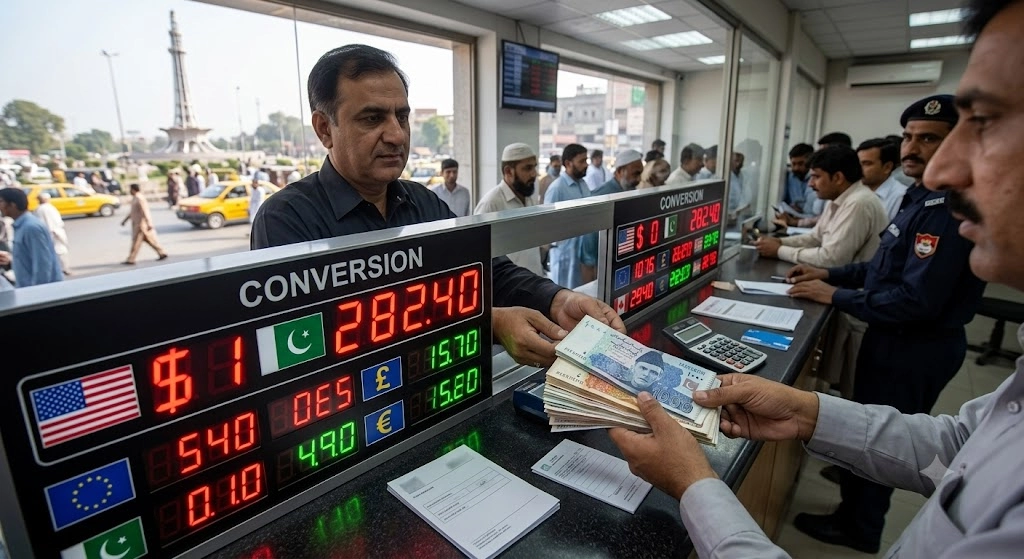
Because currency markets can move during the day, this article focuses on practical understanding rather than only a single quoted number. For official monetary information, readers should check the State Bank of Pakistan. For fiscal and policy context, the Ministry of Finance and international institutions such as the International Monetary Fund are useful references.
Featured Snippet Answer
USD to PKR Exchange Rate shows how many Pakistani rupees are needed to buy one US dollar. It changes due to dollar demand, import payments, export receipts, remittances, foreign reserves, inflation, interest rates, global dollar strength and market confidence. Readers should verify whether a quoted rate is interbank, open market or card conversion before making decisions.
Table of Contents
- Why the USD to PKR rate matters
- Interbank vs open market rate
- Key factors behind rupee movement
- Impact on households and businesses
- Guidance for students, travelers and freelancers
- How to verify exchange rate updates
- Conclusion
- FAQs
USD to PKR Exchange Rate: Why Today’s Movement Matters
USD to PKR Exchange Rate movement matters because Pakistan’s economy is deeply linked with international trade and dollar-based payments. Petroleum products, machinery, medicines, technology items, industrial raw material and several consumer goods are connected to foreign currency costs. When the rupee weakens, import pressure can rise. When the rupee stabilizes, businesses may find it easier to plan.
The dollar rate also affects public mood. A sharp rise can create concern about inflation and external payments. A stable or improving rupee can support confidence, though one day of movement does not always indicate a long-term trend. Currency markets respond to both hard data and expectations.
For ordinary citizens, the exchange rate appears in indirect ways. Petrol prices may change, imported phones may become costlier, air tickets may move, foreign university payments may increase and online subscriptions may become more expensive in rupee terms. Even people who never visit an exchange company can feel the impact through prices.
For businesses, the rate affects contracts, inventory planning, import payments, export receipts and profit margins. Importers may delay or accelerate purchases depending on expectations. Exporters may benefit from higher rupee conversion but can also face imported input costs. This makes the exchange rate a key business planning signal.
USD to PKR Exchange Rate: 9 Critical Signals to Watch
Readers following the USD to PKR Exchange Rate should watch the drivers behind the number. A rate quote is useful, but the reasons behind the movement are more important for understanding the economy.
USD to PKR Exchange Rate Signal 1: Import Demand
Importers need dollars to pay international suppliers. When import demand rises, dollar demand can increase. Petroleum, machinery and industrial inputs are especially important because they require large payments. If imports grow faster than dollar inflows, pressure on the rupee can increase.
USD to PKR Exchange Rate Signal 2: Export Receipts
Exports bring foreign exchange into the country. Strong textile exports, rice exports, IT services and other foreign earnings can support dollar supply. If export receipts slow, the external balance can become more difficult.
USD to PKR Exchange Rate Signal 3: Remittances
Remittances from overseas Pakistanis are a vital source of foreign exchange. Families receiving dollars, riyals, dirhams, pounds or euros often convert them into rupees. Higher remittance inflows through formal channels can support the banking system and improve dollar availability.
Signal 4: Foreign Exchange Reserves
Foreign reserves influence market confidence. Stronger reserves signal that the country has more capacity to meet external payments. Lower reserves can make markets cautious and increase sensitivity to news about financing, debt repayments or imports.
Signal 5: Inflation
High inflation can weaken purchasing power and affect confidence in the currency. If inflation remains elevated, markets may expect pressure on the rupee. Currency movement and inflation can also influence each other through import prices.
Signal 6: Interest Rates
Interest rates affect savings, borrowing and investment behavior. Higher rates can support a currency in some conditions, but they may also slow growth and credit demand. Markets watch central bank signals carefully.
Signal 7: Global Dollar Strength
The US dollar can strengthen globally due to American interest rate expectations, safe-haven demand or global risk sentiment. When the dollar strengthens worldwide, many emerging-market currencies face pressure, including the Pakistani rupee.
Signal 8: Market Sentiment
Currency markets are influenced by confidence. News about external financing, political stability, reforms, IMF reviews, trade flows or oil prices can change expectations quickly. Sentiment can move the rate even before official data changes.
Signal 9: Regulatory Action
Rules for exchange companies, documentation, banking transactions and foreign currency movement can affect the market. Clear regulation reduces speculation and improves transparency.
USD to PKR Exchange Rate: Interbank vs Open Market
USD to PKR Exchange Rate reporting can confuse readers because different rates may appear on the same day. The interbank rate is used among banks and for large financial flows. The open market rate is what individuals usually see at authorized exchange companies for cash buying or selling, subject to availability, documentation and market rules.
There can also be a card conversion rate. If someone pays for a foreign subscription, online purchase, hotel booking or overseas university fee through a bank card, the final conversion may include network rates, bank charges and taxes. This may not match the interbank headline exactly.
| Rate Type | Where It Applies | Reader Tip |
|---|---|---|
| Interbank | Banks and financial institutions | Useful as a headline reference |
| Open market | Authorized exchange companies | Relevant for cash buying or selling |
| Card conversion | Online and foreign payments | Check bank fees and taxes |
| Remittance conversion | Money sent from abroad | Compare service charges and timing |
Readers should always ask which rate is being quoted. A social media post saying “dollar rate today” may not specify whether it is interbank or open market. That missing detail can create confusion, especially for travelers or students making actual payments.
How USD to PKR Exchange Rate Affects Households
The USD to PKR Exchange Rate affects households through inflation and imported goods. If the rupee weakens, imported products can become more expensive. This can include mobile phones, laptops, medicines, fuel-linked items, packaged goods and industrial inputs that affect local production costs.
Households with overseas education expenses are especially sensitive. Tuition fees, hostel costs, visa charges, examination fees and travel expenses may all become costlier in rupee terms. Families planning foreign study should budget with a safety margin rather than assuming a fixed exchange rate.
Families receiving remittances may see more rupees when the dollar rises, but that does not automatically mean better living standards. If local prices rise at the same time, the benefit can be reduced. This is why remittance households should track both exchange rate and inflation.
Travelers also need careful planning. Air tickets, hotel bookings, shopping, insurance and emergency cash requirements are affected by currency conversion. Using authorized channels and keeping receipts is important for safety and compliance.
Impact on Importers, Exporters and Freelancers
Importers feel currency weakness quickly because they must pay suppliers in foreign currency. A sudden rupee decline can increase landed cost and reduce profit margins. Importers may respond by adjusting prices, delaying orders or renegotiating terms.
Exporters may receive more rupees when dollars convert at a higher rate. However, if they rely on imported raw material, packaging, machinery or energy inputs, the advantage may be partly offset. Export competitiveness depends on more than currency movement; quality, delivery time and global demand also matter.
Freelancers earning in dollars should not treat exchange gains as permanent income growth. A higher dollar rate may increase rupee receipts, but local inflation and platform fees can reduce real benefit. Freelancers should maintain emergency savings, tax awareness and stable client relationships.
Businesses with foreign loans or dollar-linked payments should plan carefully. Exchange rate movement can increase repayment burden. Professional financial advice may be necessary for larger exposures.
How to Verify USD to PKR Exchange Rate Safely
Readers should verify the USD to PKR Exchange Rate before making decisions. Fake screenshots and outdated posts spread quickly, especially when the rupee is volatile. A careful verification process protects consumers from confusion and possible fraud.
- Check whether the rate is interbank or open market.
- Confirm the date and time of the quote.
- Use banks, authorized exchange companies or credible financial sources.
- Ask about service charges before exchanging money.
- Keep receipts for legal transactions.
- Avoid unlicensed currency dealers.
- Do not transfer money to unknown accounts promising better rates.
- Compare rates only from trustworthy channels.
For large transactions, even a small difference matters. A change of one or two rupees per dollar can affect the final cost when paying tuition, importing goods or converting savings. Planning ahead is better than rushing during panic.
USD to PKR Exchange Rate and Petrol Prices
Pakistan’s fuel pricing is connected to international petroleum prices and the rupee-dollar exchange rate. If the dollar becomes more expensive, petroleum imports can cost more in rupee terms. This does not mean petrol prices change only because of the exchange rate, but the rupee is an important part of the formula.
Fuel prices then affect transport, logistics, food supply and business costs. This is why currency movement is closely watched by transporters, retailers and households. A stable rupee can help reduce uncertainty, while sharp movement can complicate planning.
Readers should understand the chain: dollar movement affects import cost, import cost can influence fuel and goods prices, and those prices affect household budgets. This chain is not always immediate, but it is important.
Practical Planning Tips for Readers
Households and businesses can respond to exchange rate uncertainty through planning. Students should keep extra rupee funds for foreign payments. Travelers should avoid last-minute currency exchange. Importers should review payment schedules. Freelancers should save part of foreign income instead of spending immediately.
Families receiving remittances should compare formal transfer services and avoid informal channels. Formal channels improve safety, transparency and documentation. They also support the national financial system.
Small businesses should maintain price flexibility but avoid sudden unjustified increases. Customers understand genuine cost pressure, but trust is damaged when businesses use currency headlines as an excuse for excessive price hikes.
Ordinary consumers should avoid panic buying dollars unless they have a genuine need. Speculative buying can be risky because rates can move both ways. Currency should be managed as a financial need, not a rumor-driven impulse.
USD to PKR Exchange Rate: What Different Readers Should Do
Different readers use the USD to PKR Exchange Rate in different ways. A student preparing for foreign education should not think like a short-term trader. A family receiving remittances should not think like an importer. A freelancer should not think like a traveler. The same rate has different meanings depending on the financial need.
Students should calculate tuition, visa, ticket, insurance and living costs with a buffer. If a semester fee is due after several weeks, the family should not assume that today’s rate will remain unchanged. Keeping extra rupee margin can prevent stress when payment deadlines arrive.
Travelers should prepare currency needs legally and early. Last-minute conversion at airports or during peak demand can be expensive. It is better to compare authorized exchange options, understand documentation requirements and keep transaction receipts.
Importers should review contracts carefully. If a supplier invoice is dollar-based, a rupee movement can change the final landed cost. Businesses should calculate whether they can absorb the difference, adjust selling prices or renegotiate payment timing. Unplanned currency exposure can damage margins.
Exporters should avoid relying only on currency weakness for profit. A higher conversion rate can help, but long-term success depends on quality, timely delivery, customer trust and competitive pricing. Exporters who use imported raw material should calculate net impact rather than celebrating only the headline exchange rate.
Freelancers should maintain records of foreign income, platform deductions and conversion rates. A rising dollar may increase rupee earnings, but income planning should include taxes, emergency savings, equipment costs and currency volatility. Stable budgeting is more useful than emotional spending after a favorable conversion.
Households receiving remittances should compare transfer fees and delivery times. A slightly better exchange rate may not help if the service charges are high. Formal channels are safer and provide documentation that can be useful for banking and family financial records.
Ordinary consumers should understand that exchange rate changes can take time to appear in retail prices. A weaker rupee does not always raise every price immediately, and a stronger rupee does not always reduce prices quickly. Inventory costs, taxes, margins and supply contracts also matter.
USD to PKR Exchange Rate and Media Literacy
Media literacy is essential when reading USD to PKR Exchange Rate updates. Many posts use dramatic language such as “rupee crashes” or “dollar collapses” without explaining the size, source or context of the movement. Readers should ask whether the change is small, large, intraday, weekly or part of a longer trend.
A responsible report should identify whether the number is an interbank quote, open market estimate, exchange company rate or bank card conversion. It should also explain possible reasons instead of presenting the number as a mystery. Without context, readers may make poor decisions.
Charts can help, but they should be interpreted carefully. A one-day chart may look alarming, while a monthly chart may show a smaller movement. A yearly chart may show a broader trend that daily headlines miss. Timeframe matters in currency analysis.
Readers should also be cautious with anonymous predictions. No one can guarantee the exact future rate. Analysts can discuss risks and scenarios, but currency markets respond to new information. Practical planning is safer than betting household money on bold claims.
The best habit is to combine verified data with personal needs. If you need dollars for education, travel or imports, plan according to your deadline and risk tolerance. If you only follow the rate for awareness, avoid panic and focus on the broader economic picture.
Image Alt Text for USD to PKR Exchange Rate
Recommended image alt text: USD to PKR Exchange Rate Today showing Pakistani rupee, US dollar, currency movement and economy impact.
Conclusion
USD to PKR Exchange Rate is a critical number for Pakistan’s economy because it affects imports, inflation, remittances, travel, business costs, foreign education and consumer confidence. Readers should not look at the rate in isolation; they should understand the drivers behind the movement.
The best approach is to verify rates through credible sources, distinguish between interbank and open market quotes, avoid unlicensed dealers and plan foreign currency needs calmly. As Pakistan’s trade flows, reserves, remittances and global dollar trends change, the rupee-dollar rate will remain a daily indicator to watch.
FAQs on USD to PKR Exchange Rate
1. What is USD to PKR Exchange Rate?
USD to PKR Exchange Rate shows how many Pakistani rupees are needed to buy one US dollar.
2. Why does the USD to PKR Exchange Rate change daily?
It changes due to dollar demand, imports, exports, remittances, reserves, inflation, global dollar movement and market sentiment.
3. What is the difference between interbank and open market rate?
Interbank rate is used between banks, while open market rate is used by exchange companies for cash buying and selling.
4. How does the dollar rate affect petrol prices?
A weaker rupee can increase the rupee cost of petroleum imports, which may influence fuel price decisions.
5. Where should I check reliable USD to PKR updates?
Check the State Bank of Pakistan, banks, authorized exchange companies and credible financial news platforms.
6. Is a higher dollar rate good for remittance receivers?
It gives more rupees per dollar, but inflation may reduce the real benefit if local prices also rise.
7. Should travelers buy dollars from informal sellers?
No. Travelers should use authorized channels, follow documentation rules and keep receipts.
8. How can businesses manage currency risk?
Businesses can plan payments, monitor rates, maintain records, review supplier terms and seek professional advice for large exposure.
9. Does USD to PKR Exchange Rate affect online payments?
Yes. Online subscriptions, foreign purchases and card payments can be affected by conversion rates, bank fees and taxes.
10. What should readers avoid during currency volatility?
Readers should avoid panic buying, fake screenshots, unlicensed dealers and decisions based only on rumors.
Updated reader checklist for July 20, 2026
This article has been refreshed to support Pak Bulletin topical depth. Before acting on any daily figure, compare the latest market quote with official context and check the update time.
| Reader check | Why it matters |
|---|---|
| Update time | Daily prices and alerts can change during the day. |
| Official context | Government, regulator or bank notices reduce misinformation risk. |
| Local quote | Retail prices can differ by city, bank, shop or exchange company. |
Related Pak Bulletin guides
FAQ update
How should readers use this update?
Use it as a practical checklist, then confirm the final figure or advisory from the relevant bank, market, department or official announcement.